1991 - Learning to Make Music Without a Studio
When you had one keyboard, eight tracks … and that was it.

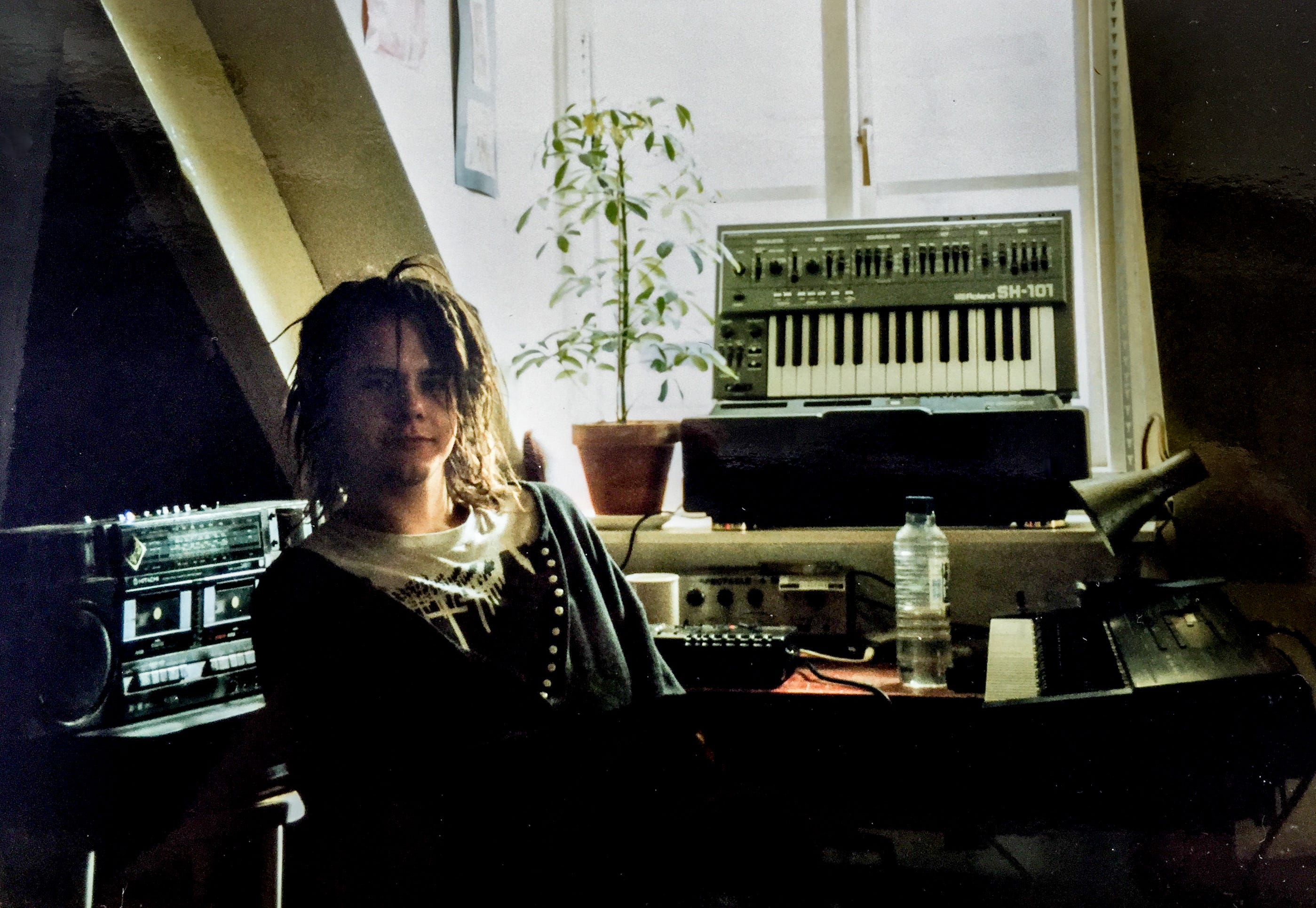
This is me, circa 1991, sat in what I would have confidently described as my “studio” in a fifth-floor flat on Queen Street in Exeter. In reality, it was a strange, makeshift space tucked into the roof of an office building, with angular ceilings and just enough room to eke out an existence in. It was the kind of place that felt temporary even while you were living in it… but it did have an awesome roof you could access with panoramic views across the city.
That was where my electronic music journey started in earnest with a Roland D-20 Workstation and a tape-to-tape recorder for “monitoring”! It was one of those early workstation keyboards - multi-timbral (i.e. more than one instrument at a time), eight tracks, a built-in sequencer, even a floppy disk drive for saving your work. On paper, it was an entire studio condensed into a single instrument, which gave you the capacity to sequence full songs, but it was also a ‘closed system’, meaning the sounds that they gave you to work with were the sounds you used. No importing sounds. No expanding your palette beyond what the machine shipped with. What you had was what you had, and you learned to live inside those boundaries.
You’d scroll through presets, land on something that felt vaguely right, and then start pulling at it, adjusting parameters, bending it into something that felt a little more personal. The architecture itself was slightly opaque - layers of tones, timbres, partials, all navigated through a small LCD screen that didn’t exactly invite deep exploration. So most of what you did was instinctive rather than methodical.
The sequencing itself was a lesson in patience. There was no copy and paste and no quick duplication of ideas. If you wanted something to repeat, you played it again and again from start to finish. It forced a kind of commitment to idea and performance that feels almost alien now, where everything can be endlessly rearranged without consequence. As someone who’d previously been limited to monophonic synths and 4-track recorders, despite its limitations, there was something incredibly satisfying about the Roland D-20. For the first time, you could start to separate things out, build something that resembled a full arrangement rather than a collection of fragments. It wasn’t elegant, but it worked.
The sounds themselves were also very much of their time. ‘Warm Pad Fade’. ‘Inner Wood’. ‘Vibestring’. ‘Soundtrack’. Names that probably meant very little on paper, but once you’d spent enough time with them they started to take on their own character. You weren’t really searching for the perfect sound, because you didn’t have that luxury, but instead you found something that was close enough and then you pushed it into place, nudging parameters until it sat where you needed it to sit. It also forced you to think harder about the quality of the musical idea, as opposed to relying on the seduction of preset sound design fuckery.
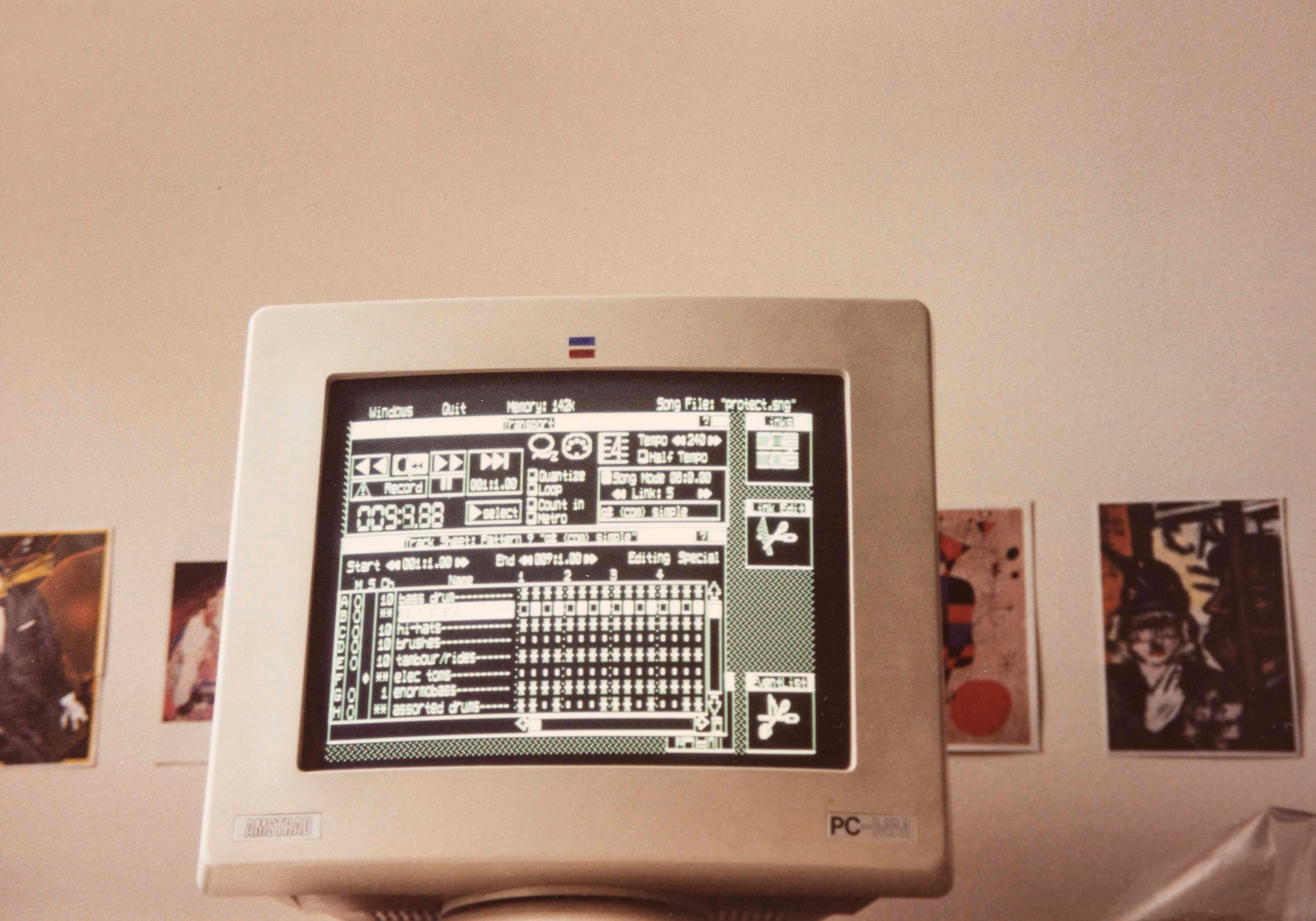
It was around this time that I purchased my first computer, a weird MS-DOS-fuelled behemoth with an obscure relic of music-programming software called ‘Prism’. It was incredibly basic and was geared around sending binary ‘play/don’t play’ instructions to each of your MIDI channels (as you can see from the image). It would be years later that the capacity to process audio became a reality in basic home computers, but it still felt like a substantial step forward.
Everything we made in that period went straight from the D-20 onto a four-channel cassette recorder. Cassettes weren’t just a storage format, they were part of the sound. Each bounce introduced a slight softening, a gradual loss of clarity that you didn’t really question because you had nothing to compare it to. If you had a bit of spare cash, you’d splurge on metal tapes. These could handle hotter signal levels better before distorting and captured better high-end detail (cymbals, brightness etc…) as well as having a lower noise floor, which meant you had less hiss on your recordings. However, we used to bounce takes down repeatedly, which meant that every bounce degraded the signal… and by the second or third bounce we were already accumulating noise and losing clarity.
Fidelity wasn’t a concept I understood back then, but I sure was excited by the flexibility that we had!
Around this time, Howie had moved down to Exeter and we started properly working together on forging a path in the dog-eat-dog world of the music industry. That flat on Queen Street became our starting point, even though it barely held together as a living space, let alone a creative one.
Flicker Noise - Frenzied Detruncation (1991, debut demo)
What I do remember very clearly is coming back one day to find a padlock on the door and a notice from the fire brigade stating, in no uncertain terms, that the flat was unsafe. No fire escape. No viable exit in the event of a fire.
We weren’t allowed back in. Everything we owned was effectively sealed inside. The place was a death trap.
I found an entry in an old diary from that week, August 1991:
“Two fire officers came to inspect the building and told us in a matter of fact way that we’d have to find somewhere else to sleep. The flat, as it stands, is a death trap. No alarm systems or fire escape, and that means no accommodation.”
We were given one supervised visit to retrieve essentials and left the flat with a bag of clothes, a few personal items, and then we were out. What’s strange, looking back through those entries, is how all of this was happening at exactly the same time that everything else was starting to move forward.
We’d secured our first two proper London gigs as Flicker Noise - one at The Rock Garden in Covent Garden, one at a club called The Brain. At the same time we were trying to organise transport, tickets, posters, finances… and it was properly overwhelming.
“I look in my diary and see 18 days of wall-to-wall arrangements and engagements… my initial aims were to pull off the gigs with minimal discredit and to record an insane product for a compilation album we’ve been offered.”
And then, right in the middle of it, everything fell apart. The computer died.
“No data, no programmes, no gigs. Complete unbridled doom.”
That machine was the centre of everything - it was running every sequence that the D-20 was running - all the arrangements, all the work we’d been building towards. I remember sitting in a pub called The Red Cow with Howie that night, both of us trying, and failing, to find anything remotely funny about the situation. Instead we drank our body weight in shots and headed home in a drunken stupor.
“We agreed there was a 10% chance of doing the gig at all.”
The next day, someone came out to look at it - an ‘expert’ from Okehampton - and three hours later, £45 lighter, we had a functioning computer once again, despite the fact that over 60% of our data was lost or damaged. At that point, we had a decision to make… and, not for the first time in my career, I decided to go the extra mile. The next 24 hours became an absolute blur - sitting in front of the screen, rebuilding what we could, reconstructing tracks from memory, piecing together something that resembled a set.
“I sat and stared at the screen, rushing through the regeneration of four months of work… It was 5:30 a.m. when we finally had enough for an 8-song set.”
Three hours later we were on the road to London in a borrowed car that was held together by duct tape and wishful thinking. We had no time for a rehearsal - we had just enough material to stand on a stage and attempt it.
Somehow, it worked.
“The gig itself was the minor miracle (we’d hoped for)… we blew the main band miles out of sight and received a three-minute ovation at the end of our set.”
During 1991 I’d taken over from Thom Yorke as the DJ at The Lemon Grove, which was a huge student night at Exeter, and one which routinely drew 1000 people every Friday. It was a challenge keeping all the many musical tribes and interest groups happy, but it was also a great testing ground for new music, including some of our early Flicker Noise demos.
“On Friday, I tried out the new hardcore mix of Walk on Glass at the Lemon Grove. To my slight surprise and immense gratification, it went down very well. However, when the guitars come in, there is dancefloor confusion. I think people are naturally suspicious, half expecting to be caught out as being uncool rather than dancing regardless.”
What we were trying to do with Flicker Noise was combining an electronic backbone with our many influences from the world of guitar music, and our output was constantly being shaped by the music we were listening to at the time.
On one side there was the more abrasive, industrial end of things in bands like Big Black, NIN and The Young Gods. The Young Gods in particular really got under my skin, especially the way they approached sound and how they sampled guitars rather than playing them live, chopping them into something that felt both organic and completely artificial at the same time. I remember seeing them live and being completely blown away by these aggressive, jagged bursts of sound that clearly had their roots in rock music, but had been stripped down, processed, reassembled into something else entirely.
We didn’t yet have access to samplers, however, so weren’t able to process Howie’s guitars to take the ‘liveness’ out of the equation (that came later in our Lunatic Calm days). That live performance aspect of ‘real instruments’ was always a point of musical friction, and even now, with the exponential improvement in music software and my own production skills, it’s not easy to combine the looseness of live performance with the rigidity of the machines.
At the same time, there was a wide range of hardcore dancefloor music coming through on the ravier side of things. My sets routinely featured tracks from the likes of Messiah, T99, MNO, Urban Shakedown, Bizarre Inc., Altern-8… all of it raw, direct, rhythm-led, and designed very clearly for the new rave order.
There was a track around that time that became a creative touchstone for me - 808 State’s anthem, Cubik. That huge metallic synth riff felt almost industrial, like it had more in common with the harsher end of guitar music than anything that was happening in clubs at the time, but the way it locked into the rhythm, the way it carried that sense of forward motion, placed it firmly on the dancefloor.
One of our earlier Flicker Noise tracks, ‘Apocalypse’, was my attempt at creating something with a similar drive and energy. It actually started life as a Headless Chickens track, before Flicker Noise properly took shape, and I remember thinking, even then, that there was something in that direction that felt worth pursuing. Not because it sounded finished or particularly polished, but because it hinted at a way of bringing those influences together without them cancelling each other out.
We ended up playing it live a couple of times, one of those performances with Thom Yorke on guitar, which at the time felt entirely unremarkable (it was just another show, another experiment), and amazingly, there’s actually a video of one of those performances that somehow still exists.
All of this was happening at a point where I did have a sense of what “good” sounded like.
Records like 808 State’s Cubik weren’t abstract references - they were right there in front of us, being played out on proper systems, sounding huge, confident, completely realised. There was a clarity and weight to them that felt miles beyond anything we were capable of achieving with a single keyboard, a cassette recorder, and a temperamental MS-DOS computer that seemed to have a habit of collapsing at exactly the wrong moment.
We knew exactly how far away we were - there was a gap, and it was a big one, and it was one that would prove insurmountable until we had enough equipment to at least begin competing with our peers. We did have a feeling that we were circling something that mattered, but we didn’t yet have the tools, or the depth of understanding, to translate that into something that could genuinely sit alongside the records we were playing out in clubs.
What we did have, and what probably mattered more than anything else, was the willingness to keep pushing through it. Gear breaking, data disappearing, things not quite landing the way we’d imagined them… none of it felt like a reason to stop, and if anything, it just became part of the process. There was also a musical grounding underneath it all that helped. Even when the production wasn’t there, even when things sounded thin or slightly off, there was still enough in the ideas themselves to hold things together. Just about.
More importantly, it was the first time we could take something from the very beginning of an idea through to something that resembled a finished piece, without needing to step into a studio or rely on someone else to interpret it for us.
That, more than anything, was where the shift happened - not in fidelity, or quality, or even outcome, but in the simple fact that it had become possible to do it at all.